Written and medically reviewed by Dr. Loi Thanh Mai, O.D.
Doctor of Optometry · Certified in the treatment and management of ocular disease · Last reviewed October 2026
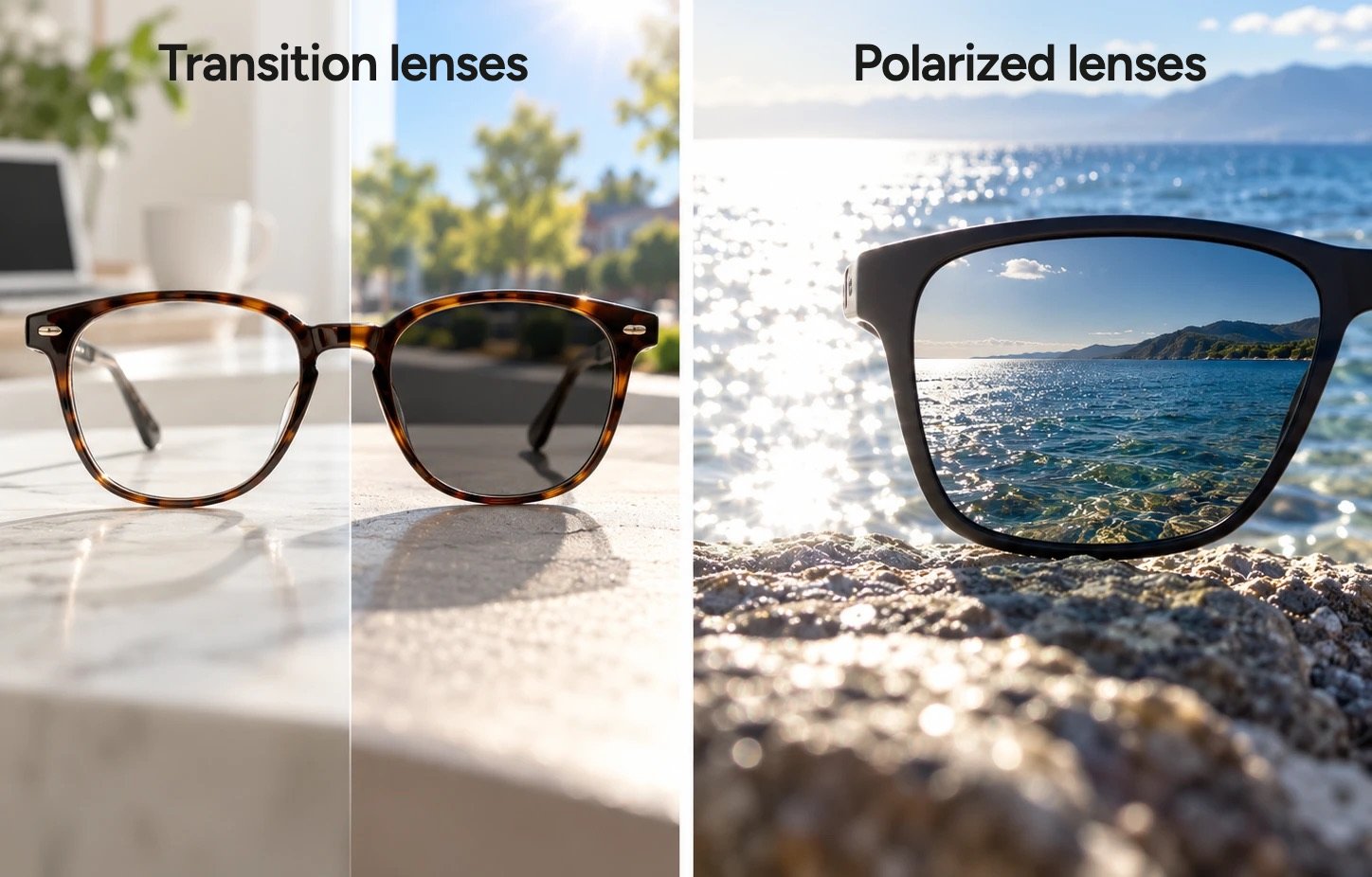
Photochromic lenses, commonly referred to as Transition lenses, automatically adjust their tint based on surrounding light conditions. They are designed to provide convenient light management throughout the day.
Polarized lenses, on the other hand, are specifically designed to reduce reflected glare from surfaces such as roads, water, snow, and car hoods.
Neither option is inherently better than the other. They address different visual needs, which is why we routinely recommend both photochromic lenses and polarized sunglasses depending on the patient’s lifestyle.
For many patients, the most versatile combination is photochromic lenses for everyday use and a separate pair of polarized sunglasses for driving and extended outdoor activities.
What are Transition lenses?
“Transitions” is a brand of photochromic lenses. Although the name is often used conversationally to describe photochromic lenses in general, several manufacturers produce lenses that automatically change tint.
Photochromic lenses contain molecules that respond to light. Most conventional photochromic lenses are activated primarily by ultraviolet (UV) light. Outdoors, they darken as exposure increases. When the wearer returns indoors, the lenses gradually return toward their clear state.
Current Transitions lenses block 100% of UVA and UVB radiation, according to the manufacturer.
The exact speed and degree of darkening depend on several factors, including the specific photochromic technology, temperature, UV exposure, lens material, and environmental conditions.
Temperature can affect photochromic performance. In general, photochromic lenses tend to become darker in colder conditions and may not become quite as dark at higher temperatures.
What are the advantages of photochromic lenses?
The primary advantage is convenience. One pair of glasses can remain relatively clear indoors and automatically darken outdoors.
They can be particularly useful for people who:
- Frequently move between indoor and outdoor environments
- Prefer not to switch constantly between regular glasses and sunglasses
- Want everyday UV protection incorporated into their prescription eyewear
- Are sensitive to changes in outdoor brightness
Photochromic lenses are available in many prescription lens designs and materials, although availability depends on the specific product and prescription.
What are polarized lenses?
Polarized lenses are sunglasses that contain a specialized filter designed to reduce reflected glare.
When light reflects from relatively horizontal surfaces — including roads, water, snow, and vehicle surfaces — a significant portion of that reflected light can become horizontally polarized. A polarized sunglass lens is oriented to reduce much of this horizontally polarized reflected light.
The result can be noticeably less glare and improved visual comfort in environments where reflected light is especially strong.
This makes polarized sunglasses particularly useful for:
- Driving during the day
- Fishing and boating
- Beach and water activities
- Snow sports
- Outdoor recreation
- People who are especially bothered by reflected glare
Unlike conventional photochromic lenses, standard polarized sunglasses do not automatically become clear indoors. They remain tinted because they are designed primarily as sunwear.
Transition vs. polarized lenses at a glance
| Photochromic / Transition Lenses | Polarized Sunglasses | |
|---|---|---|
| Primary purpose | Automatically manage changing light levels | Reduce reflected glare |
| Indoors | Clear or nearly clear, depending on product | Remain tinted |
| Outdoors | Automatically darken | Remain tinted |
| Polarization | Usually no; certain products are polarized | Yes |
| Behind a windshield | Depends on the specific product | Effective for daytime driving |
| Best suited for | Everyday convenience and changing environments | Driving and glare-intensive outdoor activities |
| Can replace everyday clear glasses? | Often yes | Generally no |
Are Transition lenses polarized?
Not necessarily.
Standard everyday Transitions lenses, such as Transitions GEN S, are photochromic but are not polarized. They darken in response to outdoor light but do not provide the same reflected-glare reduction as polarized sunglasses.
However, there are specialized lenses that combine photochromic and polarization technologies.
For example, Transitions XTRActive Polarized lenses darken outdoors and develop polarization as they activate. According to Transitions, they are slightly tinted indoors, darken behind a windshield, and become polarized primarily outdoors as they darken.
Another option is Transitions Drivewear, an adaptive polarized sun lens designed specifically for daytime driving and outdoor use. Drivewear lenses are polarized at all times and respond to both UV and visible light, allowing their tint to adapt even behind a windshield. Because they remain tinted, they are not intended to function as clear indoor lenses or for nighttime driving.
These specialized products are different from standard clear-to-dark photochromic lenses, so the appropriate choice depends on how and where the glasses will be used.
Why don’t most photochromic lenses get very dark in the car?
This is one of the most important differences to understand when choosing photochromic lenses.
Most conventional photochromic lenses rely primarily on UV light to activate. Modern automobile windshields block most of the UV radiation that would normally trigger the lenses. As a result, conventional photochromic lenses generally do not become as dark behind the windshield as they do outdoors.
That does not mean the lenses are defective. It is simply a limitation of how traditional photochromic technology interacts with automotive glass.
There are exceptions.
Transitions XTRActive, for example, responds to both UV and portions of visible light and therefore can darken to some degree behind a windshield.
For patients who spend a significant amount of time driving, however, we often still recommend considering a dedicated pair of polarized prescription sunglasses. Polarization directly targets reflected road and vehicle glare and can provide a different type of visual benefit than photochromic darkening alone.
Which is better: Transition or polarized lenses?
There is no universal winner because they are designed for different purposes.
Photochromic lenses may be a good choice if:
You want the convenience of one pair of glasses that automatically adjusts as you move between indoor and outdoor environments.
They are particularly useful for everyday activities when carrying and switching between two pairs of glasses would be inconvenient.
Polarized sunglasses may be a good choice if:
Reflected glare is one of your primary concerns.
They can be especially beneficial for daytime driving, fishing, boating, snow activities, and other situations involving significant glare from horizontal surfaces.
For many patients, we recommend both.
Photochromic lenses and polarized sunglasses should not necessarily be viewed as competing choices.
A very practical eyewear combination is:
Photochromic lenses for everyday wear + polarized sunglasses for driving and prolonged outdoor activities.
The photochromic pair provides convenience when moving through changing environments, while the polarized pair provides dedicated glare reduction when it matters most.
The appropriate combination ultimately depends on the patient’s prescription, visual demands, driving habits, outdoor activities, light sensitivity, and personal preferences. The goal is not to choose the lens with the longest list of features. It is to choose eyewear that matches the way you actually use your vision.
Are polarized lenses good for driving?
For daytime driving, polarized sunglasses can be an excellent option because they reduce reflected glare from the road, vehicle surfaces, and other horizontal surfaces.
One consideration is that polarization can interact with certain digital displays. Depending on the display technology, polarization orientation, and viewing angle, some LCD screens may appear darker, distorted, or show color patterns.
This may occasionally affect certain vehicle displays, phones, ATMs, or other screens. Because modern displays vary considerably, we recommend trying polarized lenses with the displays you use most frequently if this is a concern.
Polarized sunglasses should not be worn for nighttime driving simply because they are polarized. They are tinted sunglasses and therefore reduce the amount of light reaching the eye. Transitions also specifically advises against nighttime use of its tinted Drivewear product.
Frequently asked questions
Do Transition lenses block UV?
Current Transitions lenses are designed to block 100% of UVA and UVB rays, both when clear and when activated.
It is important to distinguish UV protection from lens darkness. A lens does not have to look dark to provide UV protection. UV filtration depends on the lens material and treatments, not simply how dark the lens appears.
Do Transition lenses work while driving?
Conventional photochromic lenses generally do not become as dark inside a vehicle because the windshield blocks most of the UV light that normally activates them.
Products such as Transitions XTRActive are designed to respond to visible light as well and therefore can darken behind a windshield.
The amount of activation still differs from outdoor conditions and depends on the product.
Are polarized lenses darker than Transition lenses?
Not necessarily. Darkness and polarization are separate characteristics.
Tint controls how much light passes through the lens. Polarization controls certain types of reflected glare.
A darker lens is therefore not automatically better at controlling glare, and a polarized lens does not have to be exceptionally dark to provide polarization.
Are polarized lenses better for night driving?
No. Polarized sunglasses are intended for bright conditions and should not be worn as nighttime driving glasses because their tint reduces available light.
Can I get photochromic lenses with my prescription?
In most cases, yes. Photochromic technology is available in a wide range of prescription lens materials and designs, including many single-vision and multifocal options. Availability can vary depending on prescription, lens material, frame selection, and the specific photochromic product.
How long do photochromic lenses last?
Photochromic performance can change gradually as lenses age, but there is no single lifespan that applies to every product or wearer.
The useful life of the glasses will also depend on prescription changes, lens condition, coatings, exposure, and the specific photochromic technology. Rather than replacing photochromic lenses according to an arbitrary number of years, we recommend evaluating them as part of your regular eyewear and eye examination schedule.
Not sure which lens is right for you?
Think about where you notice the most difficulty: walking between indoors and outdoors, driving in bright sunlight, glare from the road, time around water, outdoor sports, or simply keeping track of multiple pairs of glasses.
At your next visit, tell us how you use your glasses throughout a typical day. We can compare photochromic and polarized lens options with you and recommend the combination that best fits your prescription, lifestyle, and visual needs.
Book your appointment
Booking online takes under a minute. Prefer to talk it through first? Call and you will reach our front desk, not a phone tree.
We accept VSP, EyeMed and Medi-Cal, and offer a $119 a year membership for patients without vision coverage.