Written and medically reviewed by Dr. Loi Thanh Mai, O.D.
Doctor of Optometry · Certified in the treatment and management of ocular disease · Last reviewed September 2026
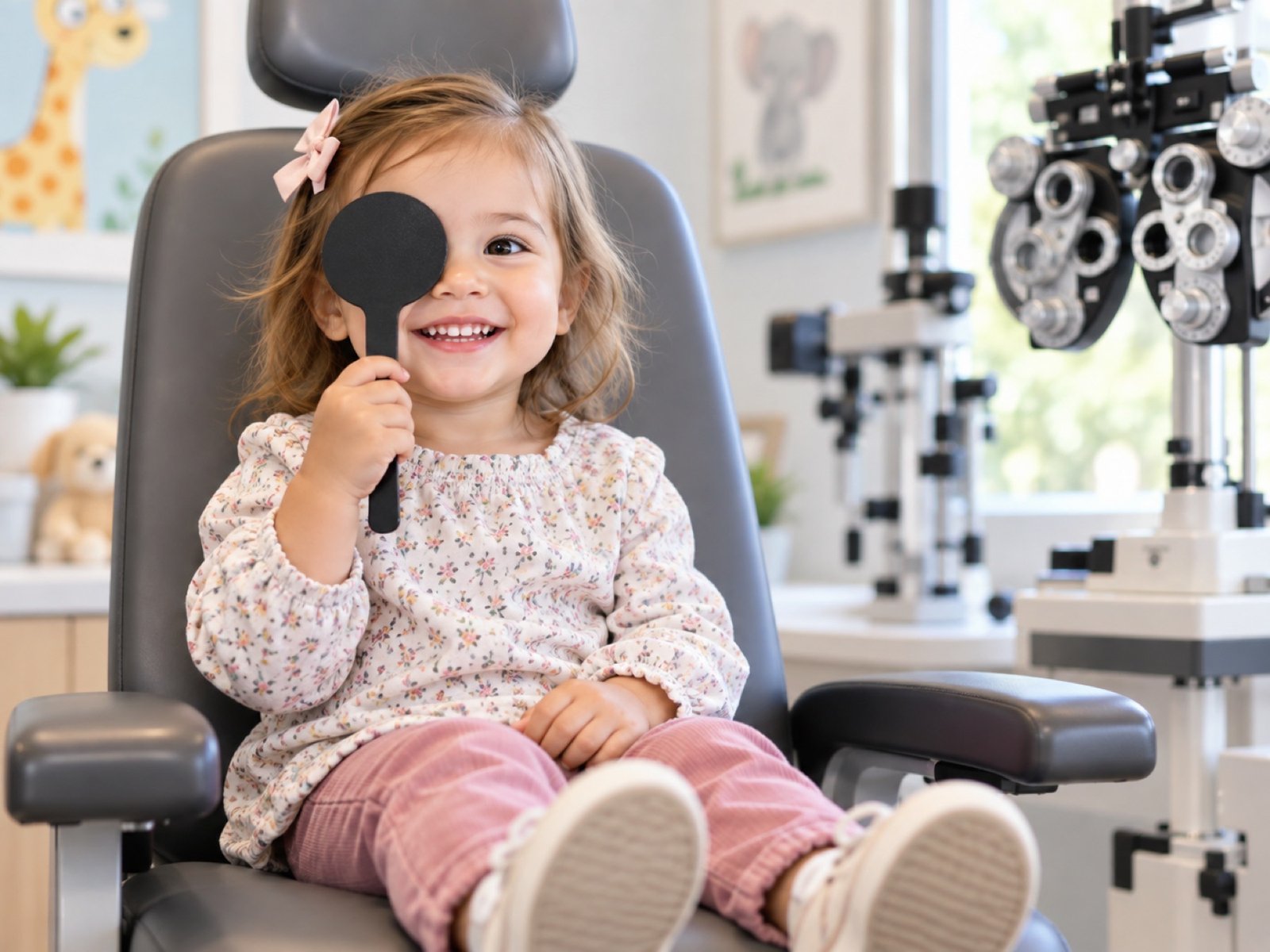
Every year we see children who passed a school vision screening a few months earlier and who cannot read comfortably for more than ten minutes. The parents are usually confused, and reasonably so. The screening said everything was fine.
The screening was not wrong. It simply answered a much narrower question than anyone assumed.
What a screening measures
A school vision screening measures distance visual acuity. A child stands a set distance from a chart and reads down it. That is it. It is a cheap, fast, genuinely useful filter for one specific problem: nearsightedness significant enough to blur the board.
It is not designed to detect anything else, and it does not.
What it does not measure
Near vision
The chart is across the room. Nearly all classroom work happens at arm’s length or closer. A child can see the board perfectly and still struggle with the page, and nothing in a distance screening would reveal it.
Focusing stamina
Reading a line of a chart takes two seconds. Reading a chapter takes twenty minutes of sustained focusing effort. Some children can produce clear focus briefly but cannot hold it, and their symptom is not blurred vision — it is that reading becomes exhausting and they stop.
Eye teaming
The two eyes have to converge on the same point and stay there. When that system is weak — convergence insufficiency is the common version — words swim, lines occasionally double, and the child loses their place constantly. Distance acuity can be flawless.
Farsightedness
This is the significant one, because children’s focusing systems are extraordinarily strong. A moderately farsighted child can focus straight through the prescription and read the chart perfectly. The screening records a pass. What it does not record is that the child is doing continuous focusing work all day to achieve it, and by the afternoon they have a headache and have lost interest in reading.
Detecting this reliably requires dilating drops to relax the focusing system. No screening does that.
The pattern to watch for: a child who avoids reading, loses their place, re-reads lines, gets headaches after school, or whose teacher describes them as bright but inattentive with written work. Blurred vision is rarely reported, because the child has nothing to compare their vision against.
Why children do not report vision problems
A child who has always seen the world slightly blurred has no reason to think anything is unusual. They assume everyone sees what they see. There is no moment of noticing a change, because there was no change.
So they do not complain. They adapt — sitting closer, tilting their head, closing one eye, holding the book near their face, or quietly concluding that reading is something other children are better at. The adaptations are the symptom.
Amblyopia and the reason age matters
There is one condition where timing genuinely changes the outcome. Amblyopia — commonly called lazy eye — is reduced vision in one eye because the developing brain learned to favour the other. It frequently produces no outward sign at all, and a child with one perfectly good eye will pass a screening comfortably.
Treatment works well in young children, becomes harder around age seven or eight, and after that the developmental window largely closes. This is the strongest argument for proper exams at six months, age three and before kindergarten.
What a full children’s exam adds
A comprehensive children’s exam measures distance and near acuity separately, assesses eye teaming and tracking across a line of text, tests focusing stamina rather than a momentary result, screens specifically for amblyopia and eye turns, and examines eye health. For children too young to read letters, all of it can be done with pictures, matching games and objective tests requiring no verbal answer.
It takes about an hour. If your child is avoiding reading, getting headaches after school, or has been described as capable but inattentive, it is worth that hour regardless of what the screening said.
One thing that genuinely helps
Time outdoors. The evidence linking outdoor time to slower progression of nearsightedness in children is among the more consistent findings in the field, with roughly two hours a day appearing protective. It is free, requires no equipment, and is a rare case where the advice is both simple and well supported.
Book your appointment
Booking online takes under a minute. Prefer to talk it through first? Call and you will reach our front desk, not a phone tree.
We accept VSP, EyeMed and Medi-Cal, and offer a $119 a year membership for patients without vision coverage.